On April 1, 2026, we mark the centenary of the birth of Fabio Mauri (Rome, 1926 – 2009), one of the most significant figures in postwar Italian art. An artist, writer, and playwright, Mauri developed a radical practice spanning installation, performance, theatre, and moving images, exploring the relationship between ideology, history, and representation, and anticipating many of the issues that continue to shape contemporary culture.
Born in Rome on April 1, 1926, Mauri began his artistic career in the early 1950s. In 1957, he created his first Schermo (Screen), a seminal work that laid the foundation for his later research. In it, he foresaw the central role that the screen would come to play in contemporary society, as both a visual and political device.
In 1964, he staged L’Isola, the first Pop theatre play conceived as a collage of literature, theatre, and comics. In 1971, he began working in performance with Che cosa è il fascismo (What is Fascism), followed by the installation-performance Ebrea (Jewess), in which he examined the horrors produced by Nazi-Fascist ideology and their lasting impact on European culture.
The 1970s saw the creation of some of his most important works. From 1975, after the historic performance Intellettuale, in which Mauri projected The Gospel According to Matthew onto the chest of Pier Paolo Pasolini, he developed a series of installations involving film projections on bodies and objects. In Mauri’s vision, the entire world becomes a screen: the beam of light, transmitting forms of thought onto non-neutral surfaces, transforms the object and imbues it with new meanings.
The 1980s marked the beginning of his long teaching career at the Academy of Fine Arts in L’Aquila, where he combined theoretical lectures with intensive workshop activities. Together with his students, he created performances such as Gran Serata Futurista 1909–1930 (1980) and Che cosa è la filosofia. Heidegger e la questione tedesca. Concerto da tavolo (1989).
In 1993, Mauri created Il Muro Occidentale o del Pianto (The Western Wall or Wall of Lamentation), a monumental work composed of suitcases and bags, symbolizing division, exile, and forced migration—lives “compelled to expatriate, to find or carry with them identities that have been burned or torn apart.” In 2000, he founded the Studio Fabio Mauri – Associazione per l’Arte L’Esperimento del Mondo, dedicated to the production and preservation of his works and archive. Mauri continued to work until the final days of his life, passing away on May 19, 2009.
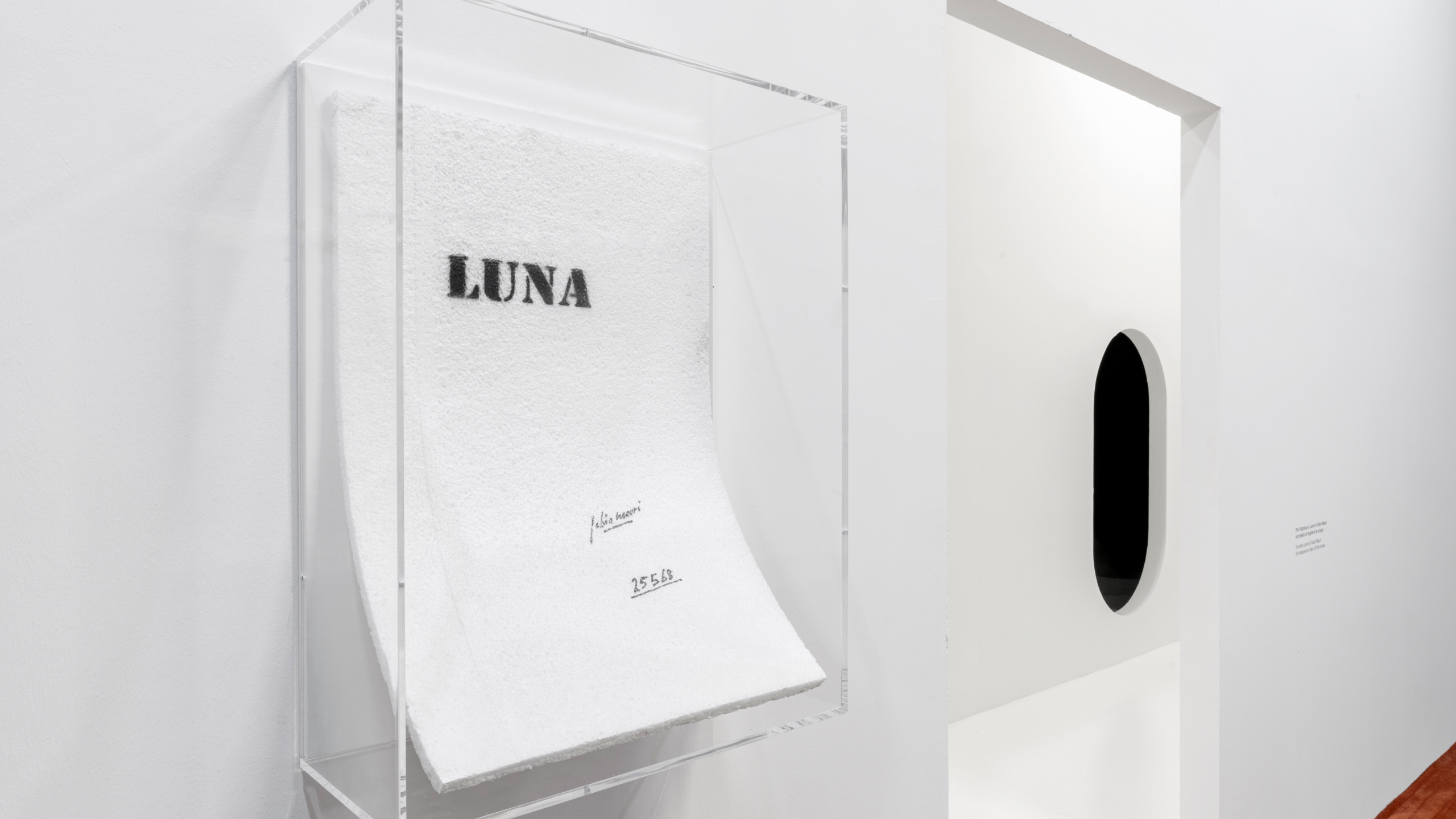
On the occasion of this anniversary, the Centro Pecci pays tribute to Fabio Mauri also through one of the works in its collection, currently on view in the permanent display: Luna (1968), a walkable installation made of sheets and polystyrene matchboarding.
First presented in 1968 at the La Tartaruga gallery in Rome, Luna predates the Apollo 11 Moon landing of July 20, 1969, a globally broadcast event that symbolically marked the end of the space race within the context of the Cold War. With this environmental installation, Mauri invites viewers to physically experience the sensations of the lunar surface and of emptiness, translating into a spatial, walkable form a dimension that is at once imaginary, mediated, and historical.
Luna entered the Centro Pecci collection in 2008, on the occasion of the commemorative exhibition “1988: Twenty years before, twenty years after”, as a gift from the artist and his Estate.
One hundred years after his birth, Fabio Mauri’s work continues to challenge us with remarkable clarity: on images, power, memory, and the ways in which history inscribes itself onto bodies, objects, and space.