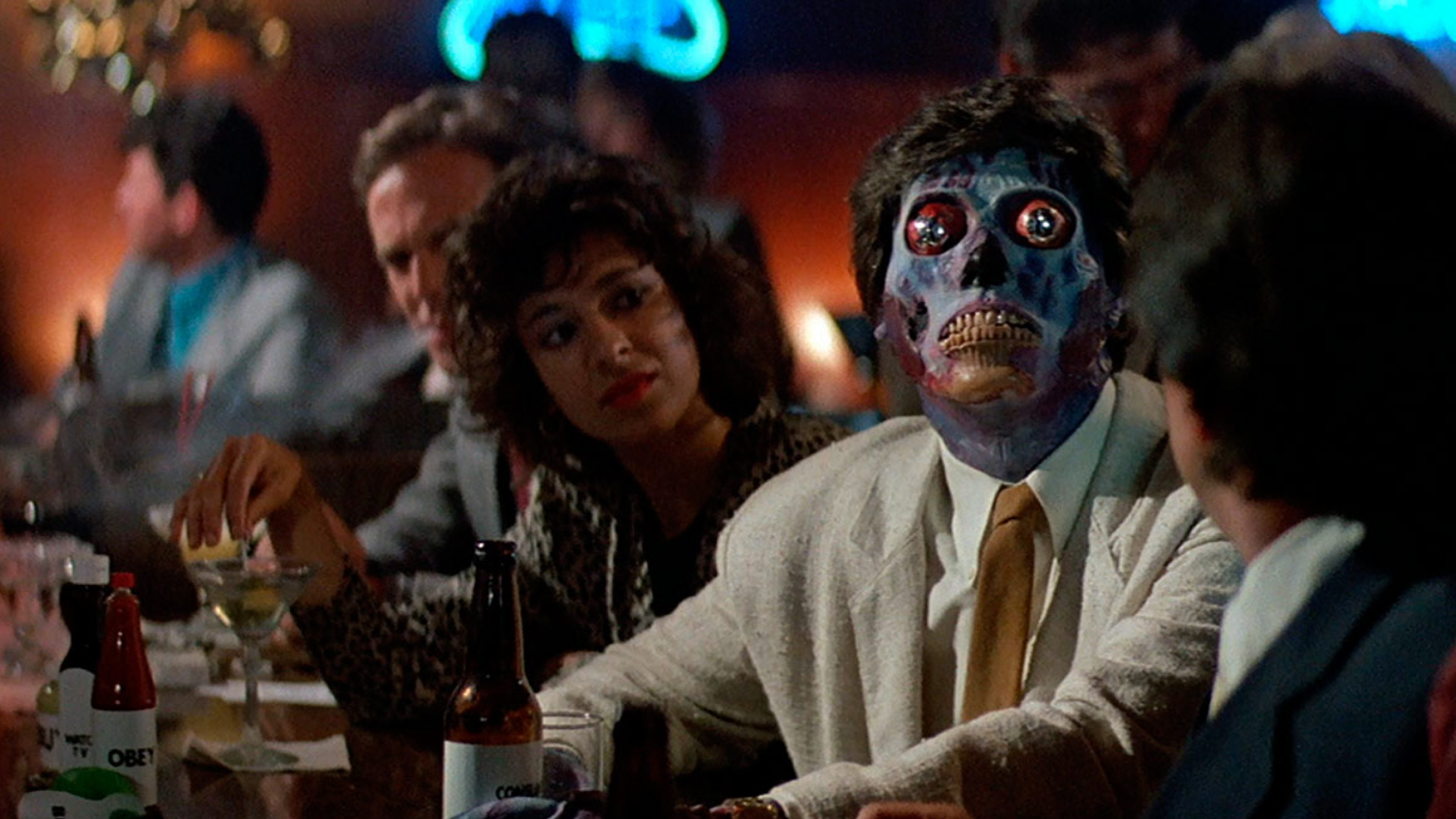
This October, CineBrividi returns to Centro Pecci Cinema with horror classics, new discoveries and filmmaker Q&As. For CineBrividi Cult, John Carpenter’s They Live returns to the big screen: a pair of sunglasses reveals a hidden reality, blending science fiction with social criticism.
The invasion of the "aliens" has already begun, even though no one has noticed. A young man discovers it by chance when, after putting on a strange pair of glasses, he sees horrible skulls instead of the entirely human faces visible to the naked eye. Moreover, the aliens have not come with peaceful intentions: they want to rule the world, and this young man is the only one who knows it. A solid comeback for John Carpenter after several questionable efforts.
"One of the most memorable scenes in They Live—John Carpenter’s masterpiece—arrives just half an hour into the film, in a completely unexpected and surprising way. The protagonist, John Nada (Roddy Piper), puts on a pair of sunglasses and discovers that the world around him is nothing more than a black-and-white shell overrun by subliminal messages. Economic, social, and cultural imperatives loom large on billboards and in newspaper pages: OBEY, CONSUME, MARRY AND REPRODUCE. A stack of banknotes, meanwhile, suggests: I AM YOUR GOD. Few other films in cinema history manage to create such an alienating effect, suddenly shifting away from a premise that, until that moment, had operated within the realm of the sci-fi thriller. From this point on, science fiction becomes merely a vehicle for presenting a radical, paranoid political vision. Carpenter does not merely hint at political dystopia—as Paul Verhoeven does in *RoboCop*, for instance—but lays it bare, stripping away all artifice to reveal it in its rawest form, speaking more to the viewer than to the film's protagonist. It is a lightning-fast, unexpected punch to the gut—so much so that essayist Jonathan Lethem described the sequence as '10 minutes of sublime cognitive dissonance'." (Daniele Lombardi)


